
Photo by Taylor Vick on Unsplash
S3 Standard vs Intelligent-Tiering cost comes down to access patterns and object size. Both charge $0.023 per GB for hot data in us-east-1, but Intelligent-Tiering moves untouched objects to $0.0125 after 30 days and $0.004 after 90, for a monitoring fee of $0.0025 per 1,000 objects. It costs less for large objects that go cold and more for small, constantly read ones.
Intelligent-Tiering is often described as “Standard, but automatically cheaper”. That is true for many buckets and false for some, and the difference is easy to calculate once you know the four inputs: GB stored, object count, average object size and how much of the data goes untouched for 30 or 90 days. This guide is for developers and engineering leads choosing a default storage class, with a dated rate table, three worked examples and a break-even rule you can apply in your head.
To run your own numbers side by side, use the free calculator to compare S3 storage class monthly cost.
How S3 Intelligent-Tiering pricing works
Every object uploaded or transitioned to Intelligent-Tiering starts in the Frequent Access tier. According to the AWS documentation on how S3 Intelligent-Tiering works, an object not accessed for 30 consecutive days moves to the Infrequent Access tier, and after 90 days of no access it moves to the Archive Instant Access tier. All three tiers return data in milliseconds. If the object is read again, it moves back to Frequent Access.
What you pay for:
- Storage at the rate of whichever tier each object is in.
- A monitoring and automation fee per object per month, for objects of 128 KB or larger.
- Requests at the same rates as S3 Standard.
What you don’t pay for: retrieval fees, tiering charges when objects move between tiers, or a minimum storage duration. Those three are exactly where Standard-IA and Glacier Instant Retrieval catch people out, and they are why Intelligent-Tiering is the safer choice when you don’t know the access pattern.
The 128 KB rule: objects smaller than 128 KB are never monitored and never move to a cheaper tier. They are always charged at Frequent Access rates, with no monitoring fee. A bucket of small objects in Intelligent-Tiering costs the same as S3 Standard, so there is nothing to gain.
Two optional tiers, Archive Access (after 90 or more days) and Deep Archive Access (after 180 or more days), go further but need a RestoreObject call before you can read the object, which takes hours. Only turn them on if your application can wait.
S3 Standard vs Intelligent-Tiering vs Standard-IA: rate table
Prices from the AWS public price list for S3, cross-checked against the Amazon S3 pricing page.
| Item (us-east-1, as of September 2026) | S3 Standard | S3 Intelligent-Tiering | S3 Standard-IA |
|---|---|---|---|
| Storage, first 50 TB / month | $0.023 per GB | Frequent Access: $0.023 per GB | $0.0125 per GB |
| Not accessed 30+ days | $0.023 per GB | Infrequent Access: $0.0125 per GB | $0.0125 per GB |
| Not accessed 90+ days | $0.023 per GB | Archive Instant Access: $0.004 per GB | $0.0125 per GB |
| Optional archive tiers | n/a | Archive Access $0.0036, Deep Archive Access $0.00099 per GB | n/a |
| Monitoring fee | none | $0.0025 per 1,000 objects (128 KB and larger) | none |
| PUT, COPY, POST, LIST per 1,000 | $0.005 | $0.005 | $0.01 |
| GET and other requests per 1,000 | $0.0004 | $0.0004 | $0.001 |
| Retrieval per GB | none | none | $0.01 |
| Minimum duration / billable size | none | none | 30 days / 128 KB |
S3 Standard and the Frequent Access tier step down to $0.022 per GB after 50 TB and $0.021 after 500 TB. A lifecycle transition from Standard into Intelligent-Tiering costs $0.01 per 1,000 objects, once.
Worked examples: which storage class costs less?
Example 1: 10 TB of mixed data that mostly goes cold
You store 10 TB (10,240 GB) in 5 million objects averaging 2 MB. Roughly 20% is read every month, 40% hasn’t been touched for 30 to 90 days and 40% for more than 90 days.
- S3 Standard: 10,240 × $0.023 = $235.52 a month
- Intelligent-Tiering:
- Frequent Access: 2,048 GB × $0.023 = $47.10
- Infrequent Access: 4,096 GB × $0.0125 = $51.20
- Archive Instant Access: 4,096 GB × $0.004 = $16.38
- Monitoring: 5,000,000 ÷ 1,000 × $0.0025 = $12.50
- Total: $47.10 + $51.20 + $16.38 + $12.50 = $127.18 a month
Intelligent-Tiering saves $108.34 a month, about 46%, once the data has settled into its tiers. The one-time lifecycle transition of 5 million existing objects costs 5,000 × $0.01 = $50.00, recovered in the first month.
Example 2: 1 TB of 200 KB objects read every day
A thumbnail cache holds 1 TB (1,024 GB) of 200 KB images, and nearly every object is read at least once a month.
- Objects: 1,024 × 1,048,576 KB ÷ 200 KB ≈ 5,368,709
- S3 Standard: 1,024 × $0.023 = $23.55 a month
- Intelligent-Tiering: same $23.55 of storage (nothing goes cold) + 5,368.709 × $0.0025 = $13.42 monitoring = $36.97 a month
Here Intelligent-Tiering costs 57% more. The monitoring fee buys nothing because no object ever sits idle for 30 days.
Example 3: s3 storage class cost for backup data
Nightly database backups: 5 TB (5,120 GB) in 2,000 large files, rarely restored. You keep them for a year, so in steady state most files are older than 90 days; for simplicity, assume all of them are.
- S3 Standard: 5,120 × $0.023 = $117.76
- Standard-IA: 5,120 × $0.0125 = $64.00, plus $0.01 per GB for every restore
- Intelligent-Tiering (settled): 5,120 × $0.004 = $20.48 + 2 × $0.0025 = $0.005 monitoring ≈ $20.49
With few, large objects the monitoring fee is negligible, and Archive Instant Access beats Standard-IA with no retrieval fee. If you can wait hours for a restore, Glacier Flexible Retrieval or Deep Archive is cheaper still; if you restore often, compare S3 Standard-IA versus Glacier cost for backups with the retrieval fees included.
The break-even object size
The monitoring fee is $0.0025 ÷ 1,000 = $0.0000025 per object per month. An object earns that back only when it sits in a cheaper tier:
- In Infrequent Access it saves $0.023 − $0.0125 = $0.0105 per GB-month, so break-even is $0.0000025 ÷ $0.0105 ≈ 0.000238 GB ≈ 250 KB.
- In Archive Instant Access it saves $0.023 − $0.004 = $0.019 per GB-month, so break-even is $0.0000025 ÷ $0.019 ≈ 0.000132 GB ≈ 138 KB.
Rule of thumb: objects above about 250 KB that go cold for a month or more will pay for their monitoring. Objects under 128 KB aren’t monitored, so they cost exactly what S3 Standard costs. Objects between 128 KB and 250 KB only come out ahead if they reach the 90-day tier. Because the break-even depends on the size mix, find out what you actually store before switching: the script that reports the size and object count of each S3 bucket gives you GB and objects, and dividing one by the other gives the average object size.
Choose Standard if… choose Intelligent-Tiering if…
Choose S3 Standard if most objects are read at least monthly, objects are mostly under 128 KB, or the data is short-lived. Temporary uploads created through presigned S3 upload URLs and deleted within days are a typical example.
Choose Intelligent-Tiering if the access pattern is unknown or changes, objects are mostly larger than 250 KB, and a real share of the data goes untouched for 30 days or more. It is a sensible default for data lakes, user uploads and logs you keep for months.
Choose Standard-IA or Glacier Instant Retrieval if you know the data is cold, reads are rare, and objects stay for at least the 30- or 90-day minimum. Remember to estimate S3 infrequent access retrieval fees ($0.01 per GB for Standard-IA, $0.03 for Glacier Instant Retrieval) before committing.
Storage class doesn’t change request or egress pricing much, so don’t forget those lines: see how to calculate S3 GET and PUT request costs and the guide to S3 data transfer out cost per GB.
Check your buckets before you switch
ChatWithCloud can answer the inputs for you from the terminal: “What storage classes does media-archive use?”, “How many objects and GB are in each bucket?” or “Does app-logs have a lifecycle rule?” It writes AWS SDK code, runs it locally with your AWS profile and summarizes the JSON. The guide to ask AI which S3 buckets are largest walks through those questions, and asking AI why your AWS bill went up shows how to check whether storage is really the line to optimize. To see where S3 ranks against everything else, find your most expensive AWS service with Cost Explorer.
Use a read-only profile: generated code runs without a confirmation step, so a question phrased as a change could make one. The steps to connect ChatWithCloud to an AWS profile or SSO role cover setting that up. Treat answers as a starting point and verify object counts before a migration.
Frequently asked questions
Is S3 Intelligent-Tiering always cheaper than S3 Standard?
No. For data that is read every month, storage costs the same and the monitoring fee of $0.0025 per 1,000 objects makes Intelligent-Tiering more expensive. It saves money when objects of roughly 250 KB or more go 30 or more days without access.
Does S3 Intelligent-Tiering charge retrieval fees?
No. There are no retrieval fees and no charges when objects move between tiers. Only expedited restores from the optional Archive Access tier are billed extra.
Does Intelligent-Tiering have a minimum storage duration?
According to the Amazon S3 storage class comparison, it has no minimum storage duration and no minimum billable object size, unlike Standard-IA (30 days, 128 KB).
What happens to objects smaller than 128 KB in Intelligent-Tiering?
They stay in the Frequent Access tier, are billed at $0.023 per GB like S3 Standard, and have no monitoring fee.
Related guides
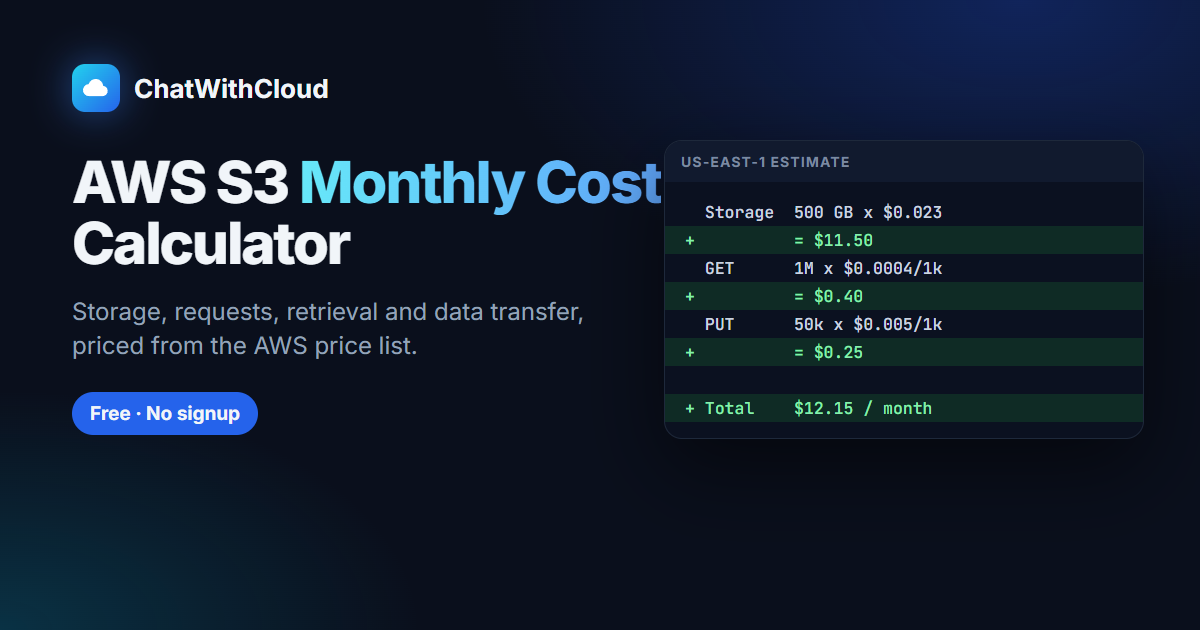 AWS S3 pricing calculator for storage classesCompare monthly storage, request and transfer cost for your numbers.
What the S3 free tier covers in 2026Credits for new accounts and what older accounts pay now.
 List AWS resources with natural languageInventory buckets and other resources from the terminal.
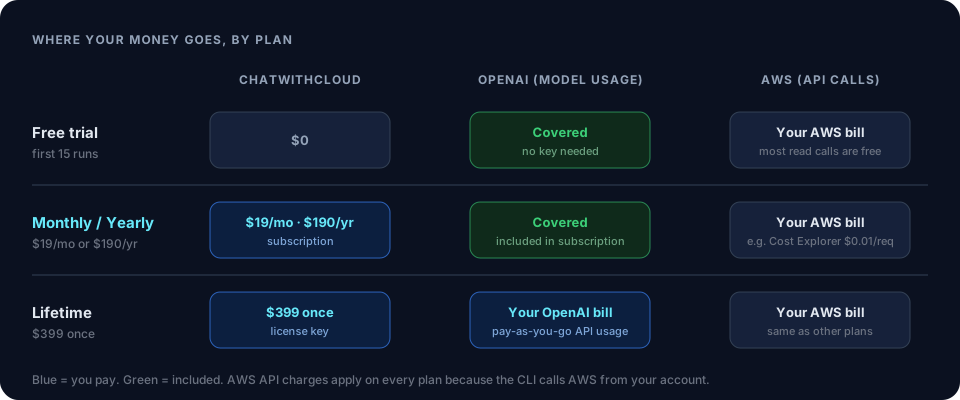 ChatWithCloud CLI pricing and free runs15 free runs, then monthly, yearly or lifetime plans.
AWS S3 Data Transfer Out CostHow S3 internet egress is priced.
How to Calculate S3 GET and PUT Request CostsPer-1,000 S3 request pricing explained.
Ask your AWS account in plain English
Your first 15 runs are free, with no OpenAI key needed.
npx chatwithcloud